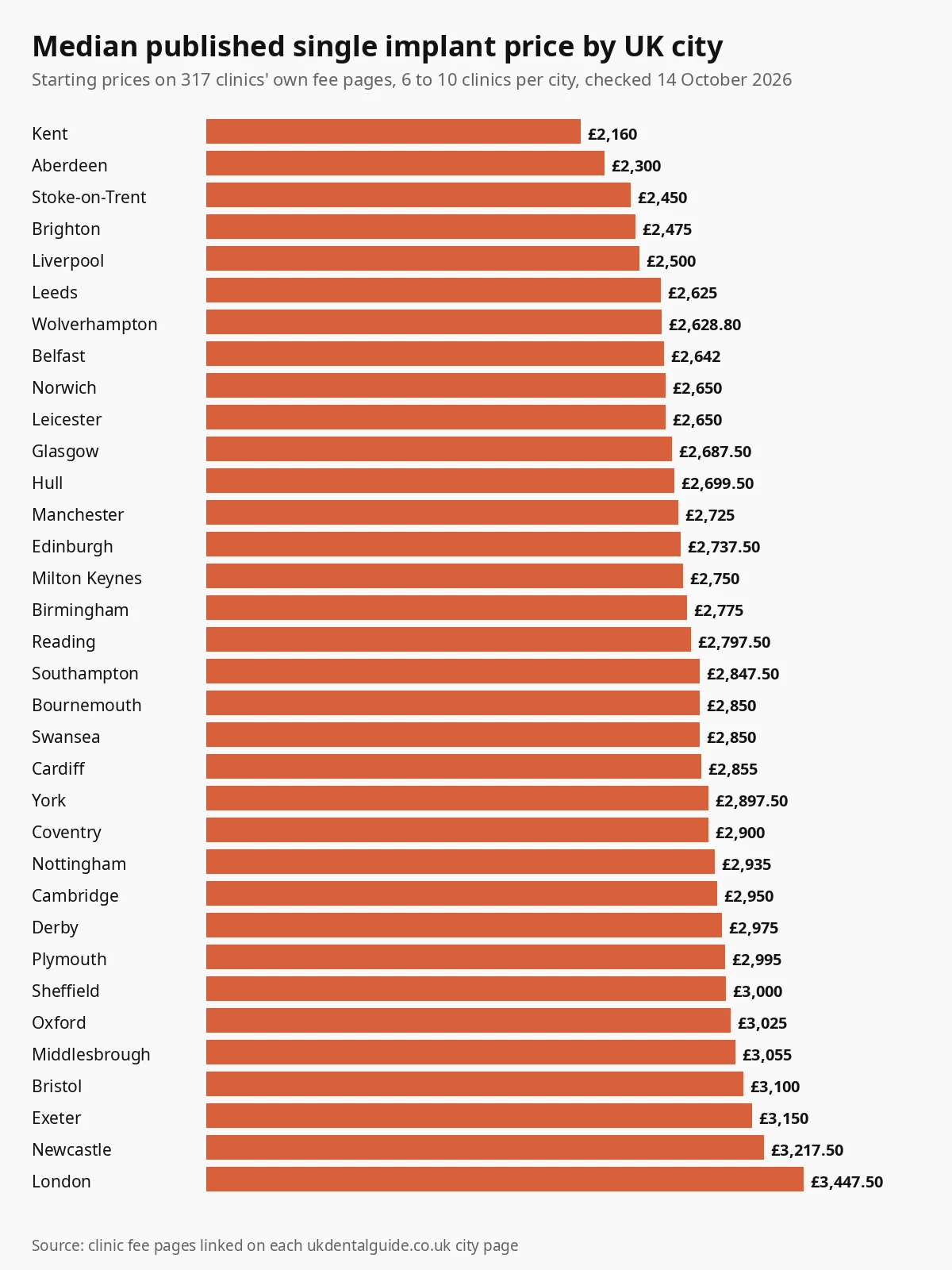
Quick answer: A single dental implant in the UK costs £1,800–£3,500 for a complete unit (titanium post, abutment and crown). The average across all UK regions is approximately £2,300–£2,600. London practices charge 20–40% more than regional equivalents. NHS implants are not available in most circumstances.
UK Dental Implant Costs 2026: Complete Price Breakdown
| Treatment | Low estimate | Average | High estimate |
|---|---|---|---|
| Single implant (fixture + abutment + crown) | £1,800 | £2,400 | £3,500 |
| Single implant in London | £2,200 | £2,900 | £3,800 |
| Single implant — regional UK | £1,600 | £2,100 | £3,000 |
| Two implants (two separate teeth) | £3,200 | £4,600 | £6,500 |
| Implant-supported bridge (3 teeth on 2 implants) | £3,500 | £5,000 | £7,500 |
| All-on-4 (full arch, one jaw) | £8,000 | £12,000 | £20,000 |
| All-on-6 (full arch, one jaw) | £10,000 | £14,000 | £22,000 |
| Full mouth reconstruction (both jaws) | £16,000 | £24,000 | £40,000+ |
| Mini dental implants (per tooth) | £600 | £1,000 | £1,800 |
All figures are for private treatment. NHS dental implants are not routinely available — see the NHS section below.
What Is and Is Not Included in the Quoted Price
The single most important thing to understand when comparing implant quotes is that headline prices frequently exclude significant costs. A quote of £1,999 and a quote of £2,800 may represent identical final costs once all elements are accounted for.
Typically included in a complete implant package
- Implant fixture (the titanium post surgically placed in the jawbone)
- Healing abutment (the connector fitted after initial healing)
- Final abutment
- Porcelain or zirconia crown (the visible tooth)
- Implant placement surgery under local anaesthetic
- Crown fitting appointment
- Follow-up appointments within the guarantee period
Frequently charged separately — always ask
| Additional procedure | Typical cost | When required |
|---|---|---|
| Initial consultation | £50–£150 | Always — sometimes credited against treatment |
| CBCT scan (3D imaging) | £150–£300 | Always — essential for implant planning |
| Bone graft | £300–£1,500 | When jawbone density is insufficient |
| Sinus lift | £700–£1,500 | Upper jaw implants with insufficient bone height |
| Tooth extraction | £80–£250 | If the damaged tooth is still present |
| Temporary crown | £100–£300 | During osseointegration period |
| Conscious sedation | £200–£500 | If requested — not routinely included |
A realistic total cost for a single implant where bone grafting and a CBCT scan are required could reach £3,500–£5,500 in London, or £2,800–£4,500 in regional England. Always request a fully itemised written quote before proceeding.
NHS Dental Implants: When Are They Available?
NHS dental implants are not routinely available. The NHS considers implants a cosmetic procedure in most circumstances and does not fund them under standard dental treatment.
The limited exceptions where NHS implant treatment may be available:
- Facial trauma: Patients who have lost teeth as a result of an accident or injury may be referred for NHS implant treatment through a hospital maxillofacial department
- Hypodontia: Patients with a congenital absence of adult teeth (particularly affecting young patients) may qualify for NHS treatment through a specialist referral
- Cancer treatment: Patients who have lost teeth or jaw bone as a result of cancer surgery or radiotherapy may access implant treatment through NHS hospital departments
- Cleft palate: Some patients with cleft palate or related conditions may access implant treatment on the NHS
In all these cases, NHS implant treatment is provided through hospital dental departments or specialist referral centres — not through standard NHS dental practices. If your situation falls into one of these categories, ask your NHS dentist for a specialist referral rather than pursuing private treatment immediately.
What Drives the Price Difference Between Clinics
A £1,800 implant and a £3,500 implant at different UK clinics are not necessarily different quality treatments. Understanding what legitimately drives prices helps you evaluate quotes rather than simply choosing the cheapest or most expensive option.
Implant brand (£150–£350 difference per unit)
The wholesale cost of the implant component varies significantly by brand. Straumann and Nobel Biocare components cost a clinic approximately £250–£450. Osstem — the most widely used mid-range brand — costs approximately £100–£220. This cost difference does not always translate to lower patient prices, but in competitive markets it often does.
For most straightforward cases in patients with good bone density, the brand of implant is less important than the experience of the clinician placing it. See our dental implant brand comparison for a full breakdown.
Clinician experience and specialisation
A clinician who places 15 implants per week charges more than one who places 15 per month — and generally produces more predictable outcomes, particularly in complex cases. Specialist implantologists, oral surgeons and periodontists with dedicated implant practices command higher fees than general dentists who include implants as one of many treatments offered. For straightforward cases, the gap in outcomes is smaller. For complex cases involving bone grafting or multiple implants, it matters more.
Location
London practices charge 20–40% more than equivalent clinics in the North or Midlands. This reflects higher property and staffing costs, not higher quality. A Straumann implant placed by an experienced implantologist in Sheffield costs less than the same procedure in Kensington — because the running costs of the practices are different, not the treatment.
Crown material
The visible crown above the gum line is available in different materials at different price points. Zirconia crowns (the best option — strong, white, translucent) cost more than older porcelain-fused-to-metal crowns. Composite resin crowns are cheapest and least durable. Always confirm which crown material is included in your quoted price.
Overhead structure of the clinic
Large dental chains (Bupa, mydentist, Portman) have standardised pricing across their networks. Independent specialist practices price based on their own cost structure and perceived value. Neither model is consistently cheaper — it depends heavily on the specific location and clinician.
The Complete Dental Implant Process and Timeline
- Initial consultation (£50–£150, week 1): Examination, discussion of suitability, X-ray assessment. This is the right time to ask about bone density and whether a graft may be needed.
- CBCT scan (£150–£300, week 1–2): 3D cone beam imaging to assess bone volume, density and the position of nerves and sinuses. Essential for accurate implant placement planning.
- Bone grafting (if required, £300–£1,500): If bone volume is insufficient, grafting is done 3–6 months before implant placement to allow the graft to integrate. This adds 3–6 months to the total timeline.
- Implant placement surgery (week 4–8 from first consultation, or month 4–7 if bone grafting required): Carried out under local anaesthetic. Takes 45–90 minutes per implant. You leave with a healing cap or temporary crown.
- Osseointegration (3–6 months): The titanium fixture integrates with the jawbone. A check appointment at 6–8 weeks monitors progress. No treatment during this period.
- Crown fitting (month 5–9 from start): The final porcelain or zirconia crown is fitted once integration is confirmed. Approximately 60 minutes.
- Annual review: Implants should be checked annually alongside regular dental hygiene appointments.
Total timeline: 5–9 months for a straightforward case. 10–16 months if bone grafting is required first.
How to Legitimately Reduce the Cost
- Get three in-person consultations. Phone quotes are meaningless — implant pricing depends on your specific bone density, gum health and case complexity. Three consultations often reveal a price range of £500–£1,000 between practices for the same treatment.
- Consider regional practices. If you live within commuting distance of a lower-cost region, travelling 60–90 minutes for implant treatment can save £300–£800 compared to local prices.
- Ask about dental school treatment. University dental school clinics (UCL, King’s College London, Leeds, Sheffield, Bristol, Birmingham and others) offer implant treatment at 40–60% below market rates, carried out by postgraduate students under close supervision. Waiting times are longer and the process involves more appointments. See our dental school implants guide.
- Consider dental tourism for multiple implants. For single implants, the logistics rarely justify the savings. For 3+ implants or full-arch treatment, savings of £3,000–£10,000 are realistic. Hungary and Poland are the most established destinations. See our savings calculator.
- Use 0% finance. Most established implant clinics offer 0% interest for 12–24 months. Over 24 months, a £2,400 implant costs £100/month with no interest — making it accessible without paying a premium. See our finance guide.
- Ask about treatment timing. Some clinics offer reduced rates for same-day consultations and placements when a cancellation arises, or for treatment in quieter periods. It is worth asking directly.
Red Flags: When a Quote Is Too Cheap
Not every low quote represents good value. Warning signs that a below-market price may involve compromises worth understanding:
- The clinic cannot name the implant brand — phrases like “Swiss quality implants” or “European premium brand” without a specific manufacturer name indicate an unbranded or undisclosed component. Always ask for the brand name and system in writing.
- A complete single implant quoted below £1,400 in the UK — this is almost certainly unbranded components, a very junior clinician, or significant hidden costs to follow. Credible UK prices for a complete single implant start at approximately £1,600–£1,800 for established brands.
- No written itemised quote provided — any reputable clinic will provide this without hesitation. If a clinic resists giving you a written breakdown, this is a concern regardless of the price.
- A CBCT scan is not part of the planning process — placing an implant without 3D imaging is considered below standard of care in modern implantology. If a clinic proposes to plan your implant from a flat X-ray only, consider this a red flag.
- No guarantee offered or a guarantee shorter than 1 year — established UK implant clinics offer guarantees of at least 2 years on the fixture. No guarantee at all suggests the clinic has low confidence in their outcomes.
Dental Implants vs Alternatives: Cost Comparison
| Option | Upfront cost | Lifespan | 10-year total cost (est.) |
|---|---|---|---|
| Dental implant | £1,800–£3,500 | 20–25+ years | £2,000–£4,000 |
| Dental bridge (3-unit) | £900–£2,500 | 10–15 years | £1,800–£5,000 |
| Partial denture | £400–£1,500 | 5–8 years | £800–£3,000 |
| Full denture | £600–£2,500 | 5–10 years | £1,200–£5,000 |
| Do nothing | £0 | — | £2,000–£8,000+ (bone loss, shifting teeth, adjacent tooth complications) |
Over a 20-year period, dental implants are typically the most cost-effective option for replacing a missing tooth, when compared to bridges or dentures that require replacement and maintenance. See our full implant vs bridge comparison and the long-term cost calculator.
Dental Implants Abroad: Is It Worth It?
UK patients can save 50–65% by travelling to Europe for implant treatment. The savings are most significant for multiple implants or full-arch treatment. For a single implant, the logistics and travel costs reduce the net saving considerably.
| Destination | Single implant (approx.) | Saving vs UK average | Flight time from London |
|---|---|---|---|
| Hungary (Budapest) | £650–£1,100 | 55–70% | 2h 30m |
| Poland (Kraków/Warsaw) | £600–£1,000 | 55–75% | 2h 30m–3h |
| Croatia (Zagreb/Split) | £600–£1,000 | 55–70% | 2h 30m |
| Romania (Bucharest) | £500–£900 | 60–75% | 3h |
| Albania (Tirana) | £400–£750 | 65–80% | 2h 30m |
| Spain (Barcelona/Madrid) | £700–£1,200 | 50–65% | 2h–2h 30m |
| Turkey (Istanbul/Ankara) | £400–£800 | 65–80% | 3h 45m–4h |
The practical considerations: most dental tourism cases require two trips (placement, then crown fitting 3–6 months later). Complications requiring follow-up in the UK are your responsibility. For this reason, using a well-documented implant brand (Straumann, Nobel Biocare, Osstem) is particularly important when having treatment abroad — UK dentists can source compatible components for these brands. Use our dental tourism savings calculator to model the real cost after travel and accommodation.
Finance Options for UK Dental Implants
Most established UK implant clinics offer patient finance. The main options:
- 0% interest finance (12–24 months): The most common offering at UK implant practices. A £2,400 implant at 0% over 24 months = £100/month. Check that the 0% applies to the full term and is not an introductory rate.
- Chrysalis Finance: Used by mydentist and other chains. Terms from 12 to 60 months. Subject to credit approval. The total repayable on longer terms includes interest — calculate the full cost, not just the monthly figure.
- Medifinance / Medenta: Healthcare-specific finance providers used by independent practices. Similar terms to Chrysalis.
- Personal loan: For larger treatment plans (All-on-4 or multiple implants), a personal loan from a bank or building society may offer a better total rate than clinic-arranged finance. Worth comparing before signing a clinic finance agreement.
See our full breakdown of dental implant finance options and our monthly payment calculator.
Frequently Asked Questions
How much do dental implants cost in the UK in 2026?
A single dental implant in the UK costs £1,800–£3,500 for the complete unit (titanium post, abutment and crown). The average across all UK regions is approximately £2,300–£2,600. London practices charge at the higher end (£2,200–£3,800). Additional procedures such as bone grafting (£300–£1,500) and a CBCT scan (£150–£300) are often charged separately and can add significantly to the total.
Are dental implants available on the NHS?
NHS dental implants are not routinely available. The NHS considers implants cosmetic in most cases and does not fund them under standard dental treatment. Limited exceptions exist for patients who have lost teeth through facial trauma, congenital absence (hypodontia), cancer treatment or cleft palate — these cases may be referred through hospital maxillofacial departments. All other patients must pay privately.
What is the average cost of a dental implant in the UK?
The average cost of a complete single dental implant in the UK is approximately £2,300–£2,600, based on typical prices across all regions. This figure assumes the implant, abutment and crown are included in the quoted price, and that no additional bone grafting or sinus lift is required. With bone grafting, the total average rises to £3,000–£4,000.
Why do dental implants cost so much?
Dental implants involve surgical precision equipment, specialist training, expensive implant components (the Straumann fixture alone costs a clinic £250–£400), a CBCT scanner, a custom-fabricated crown and multiple clinical appointments. The total cost reflects the skill, equipment and materials required — not a disproportionate markup. The lifespan of 20–25 years makes them cost-effective per year compared to bridges or dentures that need replacing.
How can I get cheaper dental implants in the UK?
The most reliable ways to reduce cost: get three in-person consultations to compare prices, consider university dental school clinics (40–60% below market rate), travel to a lower-cost UK region if you are based in London, or use 0% finance to spread the cost without paying a premium. Dental tourism to Hungary or Poland is cost-effective for multiple implants but rarely saves enough on a single implant to justify the logistics.
How long do dental implants last?
The titanium implant fixture typically lasts 20–25 years or indefinitely with proper care. The porcelain or zirconia crown above the gum usually lasts 10–15 years before it may need replacing. Overall implant survival rates at 10 years are 95–98% for established brands in patients with good bone density. See our full guide on how long dental implants last.
Is it safe to get dental implants abroad?
Dental implants abroad can be safe when you choose an established clinic using documented implant brands. The main risks are related to follow-up care: if complications arise after you return to the UK, a UK dentist must be able to continue your treatment. Using Straumann, Nobel Biocare or Osstem implants mitigates this risk as UK dentists can source compatible components. Avoid clinics that will not name the implant brand they use.
What should I ask before getting a dental implant?
The five essential questions: (1) Which implant brand and system will you use? (2) Is a CBCT scan included in the price? (3) Is bone grafting likely to be needed and what would it cost? (4) What exactly does the guarantee cover and for how long? (5) What is included and excluded from the quoted price — can I have a written itemised breakdown?
How much does All-on-4 cost in the UK?
All-on-4 treatment in the UK costs £8,000–£20,000 per jaw depending on location, materials and the implant brand used. A full mouth (both jaws) costs £16,000–£40,000. Dental tourism to Hungary or Poland reduces this to £6,000–£12,000 per jaw, making it the treatment where the saving from abroad is most significant. See our full All-on-4 guide.
Do dental implants hurt?
The placement procedure is carried out under local anaesthetic and is typically no more uncomfortable than a tooth extraction. Most patients report mild soreness and swelling for 3–5 days after placement, manageable with over-the-counter pain relief. Significant pain after implant placement — particularly after day 3 — should be reported to the clinic as it may indicate infection or other complications.
Can I get a dental implant if I have bone loss?
Yes, in most cases — but it requires additional procedures. Bone grafting (£300–£1,500 per site) rebuilds jawbone density before implant placement, extending the treatment timeline by 3–6 months. Sinus lifts (£700–£1,500) address insufficient bone height in the upper jaw. In cases of severe bone loss where grafting is not practical, zygomatic implants (anchored in the cheekbone) may be an option. See our bone graft guide.
What is the difference between a cheap and expensive dental implant?
Legitimate price differences reflect implant brand (£150–£350 difference in component cost), crown material (zirconia vs composite), clinician experience and location. In straightforward cases, a £1,800 Osstem implant placed by an experienced clinician in Manchester produces similar outcomes to a £3,200 Straumann implant in London. The gap matters more in complex cases: bone grafting, compromised bone, multiple implants and full-arch reconstruction benefit from premium materials and higher-volume clinicians.
Dental Implant Costs by UK City
Prices vary significantly across the UK. London practices charge 20–40% more than regional equivalents. Select your city for a local breakdown including specific price ranges and what to look for in your area.
England
- Dental implants cost London — £2,200–£3,800
- Dental implants cost Manchester — £1,800–£3,200
- Dental implants cost Birmingham — £1,800–£3,000
- Dental implants cost Leeds — £1,800–£3,000
- Dental implants cost Bristol — £2,000–£3,200
- Dental implants cost Sheffield — £1,700–£2,900
- Dental implants cost Liverpool — £1,700–£2,900
- Dental implants cost Newcastle — £1,700–£2,800
- Dental implants cost Nottingham — £1,700–£2,900
- Dental implants cost Leicester — £1,700–£2,900
- Dental implants cost Southampton — £1,900–£3,100
- Dental implants cost Brighton — £2,000–£3,200
- Dental implants cost Oxford — £2,000–£3,300
- Dental implants cost Cambridge — £2,000–£3,300
- Dental implants cost Reading — £2,000–£3,200
- Dental implants cost Exeter — £1,800–£3,000
- Dental implants cost Hull — £1,600–£2,700
- Dental implants cost Norwich — £1,800–£3,000
- Dental implants cost Plymouth — £1,800–£3,000
- Dental implants cost Coventry — £1,700–£2,900
- Dental implants cost Derby — £1,700–£2,900
- Dental implants cost Wolverhampton — £1,700–£2,900
- Dental implants cost Middlesbrough — £1,600–£2,700
- Dental implants cost Stoke-on-Trent — £1,600–£2,700
- Dental implants cost Bournemouth — £1,900–£3,100
- Dental implants cost York — £1,700–£2,900
- Dental implants cost Kent — £1,900–£3,200
- Dental implants cost Milton Keynes — £1,900–£3,100
Scotland & Wales
- Dental implants cost Glasgow — £1,700–£2,900
- Dental implants cost Edinburgh — £1,900–£3,100
- Dental implants cost Aberdeen — £1,800–£3,000
- Dental implants cost Cardiff — £1,700–£2,900
- Dental implants cost Swansea — £1,700–£2,800
- Dental implants cost Belfast — £1,600–£2,700
Clinic Reviews
The main UK dental chains that offer implants vary in price, specialist availability and guarantee terms. Read our independent reviews before choosing.
- Bupa Dental Care implants review — 400+ practices, £2,200–£3,500, 2–5 year guarantee
- mydentist implants review — 600+ practices, £2,000–£3,200, Chrysalis Finance
- Boots Dental implants review — ~60 practices, £2,000–£3,000
- Portman Dental Care implants review — 300+ practices, £2,200–£3,500
- Nuffield Health dental implants review — private hospital network
Dental Tourism: Getting Implants Abroad
UK patients can save 50–65% by travelling to Europe for implant treatment. The most popular destinations and what to expect:
- Dental implants in Hungary (Budapest) — £650–£1,100 per implant, most established destination
- Dental implants in Poland — £600–£1,000 per implant, short flight from most UK airports
- Dental implants in Turkey — £400–£800 per implant, verify clinic credentials carefully
- Dental implants in Spain — £700–£1,200 per implant, good for expats and retirees
- Dental implants in Croatia — £600–£1,000 per implant
- Dental implants in Romania — £500–£900 per implant
- Dental implants in Albania — £400–£750 per implant, lowest cost in Europe
Treatment Guides
- All-on-4 dental implants UK — full arch on 4 implants, £8,000–£20,000
- Full mouth dental implants UK cost
- Full arch dental implants UK — All-on-4 vs All-on-6 vs All-on-8 compared
- Same day teeth implants UK — immediate loading explained
- Mini dental implants UK — narrower diameter, lower cost option
- Bone graft for dental implants UK — when it’s needed and what it costs
- Dental implants over 60 UK — age considerations and success rates
- How long do dental implants last?
- Dental implant vs bridge UK — cost and long-term comparison
- Dental school implants UK — how to get implants at reduced cost
- Dental implants finance UK — 0% deals, Chrysalis Finance, monthly costs
- Dental implant complications and risks
- Zygomatic dental implants UK — for patients with severe bone loss
Brand Comparisons and Tools
- Straumann vs Nobel Biocare vs Osstem — which brand is used in UK clinics and why it matters
- Best dental implants UK — top brands, clinics and how to choose
- Cheap and affordable dental implants UK — legitimate ways to reduce cost
- Dental tourism savings calculator — compare UK vs abroad costs
- Dental implant finance calculator — monthly payment estimates
- Implant vs bridge long-term cost calculator