
A dental implant is not one appointment. In the UK it is a sequence of stages spread over several months: an assessment, sometimes a bone graft, the surgery to place the implant, a healing period, a minor second procedure in many cases, and finally the crown, bridge or denture. Two NHS hospital sources give the overall timescale as 6 to 12 months, or 6 months to over a year. This guide goes through each stage in order, says what the sources do and do not tell us, and lists what to ask your clinic so the quote matches the real number of visits.
We checked three sources for this page: a Guy’s and St Thomas’ NHS Foundation Trust patient page (reviewed December 2024), a patient leaflet from the Restorative Department at University Hospitals of North Midlands (reapproved October 2025), and the NHS dental treatments page. The first two describe NHS hospital pathways, so treat their timings as a baseline and ask your own dentist where their plan differs.
The dental implant procedure at a glance
| Stage | What happens | Anaesthetic |
|---|---|---|
| 1. Assessment and planning | Examination, health questions, X-rays and impressions of your jaw. Can take several visits. | Not needed |
| 2. Bone graft (only if needed) | Extra bone is added where the jaw is too thin or short. Not everyone needs it. | Depends on the size of graft |
| 3. Implant placement | A titanium post is placed in the jawbone and the gum is closed with stitches. | Local anaesthetic, sedation or general anaesthetic |
| 4. Healing | The implant is left to join with the bone. The leaflet says at least 3 months before it is used. | Not needed |
| 5. Second procedure (usually) | The top of the implant is uncovered and a healing cap is fitted. | Usually local anaesthetic |
| 6. Crown, bridge or denture | Impressions and X-rays, parts ordered, then the replacement tooth or teeth are fitted. | Not needed |
Guy’s and St Thomas’ describes the process as three or four stages and notes that each stage may involve several hospital visits. The exact number of appointments in your case depends on whether a graft is needed and on whether you are getting a single crown, a bridge or a denture.
Stage 1: Assessment and planning
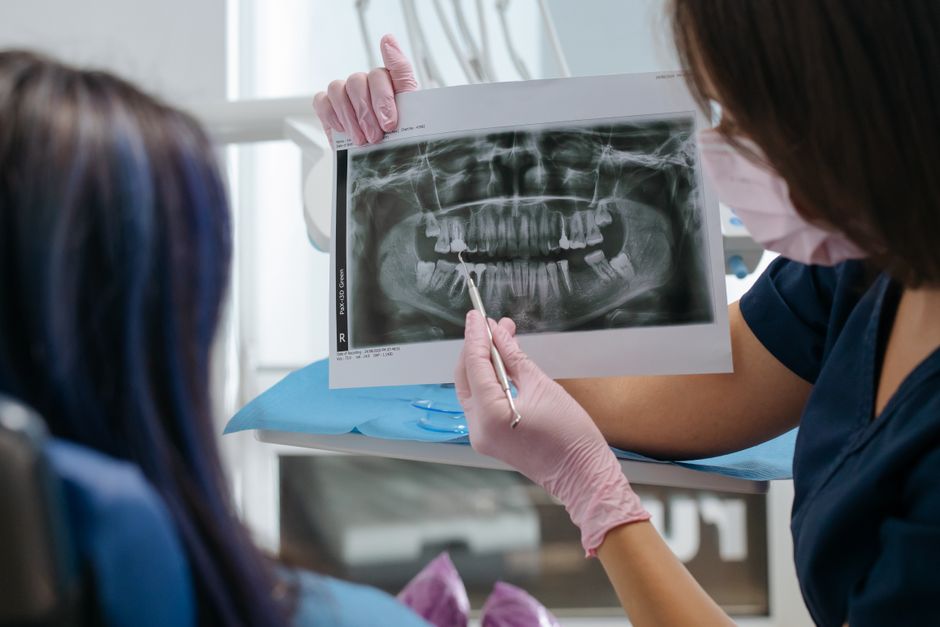
The University Hospitals of North Midlands leaflet says your clinician will examine your mouth and ask about your general health, and that planning may involve several visits and joint consultations with other specialists. X-rays are taken, along with impressions to make a mould of your jaw. The leaflet lists what decides whether implants are suitable: general medical health, the quality and quantity of bone, the condition of your gums, the health of your remaining teeth, and how close the site is to important nerves, blood vessels and sinuses.
This is the stage where a good clinic earns your trust, and where a poor one hurries you. A suitability decision made before any X-rays or scans is a guess. Our guide to questions to ask at an implant consultation sets out what to ask, and our pages on diabetes and osteoporosis and blood thinners cover health conditions that change the plan.
Smoking matters here. The hospital leaflet says smoking can delay healing and lead to implant failure, and advises stopping before treatment and afterwards. Guy’s and St Thomas’ also strongly recommends stopping smoking and staying a non-smoker, because it lowers the risk of some complications.
Stage 2: Bone graft, if you need one
If the assessment shows too little bone, the leaflet says you may need extra surgery such as a bone graft. It says the graft could be taken from your chin or the wisdom tooth area, and from the hip or other sources if larger quantities are needed. A larger graft could prolong the overall treatment by 4 to 6 months. Guy’s and St Thomas’ adds that a bone graft can cause swelling, bruising and pain.
If your quote does not mention a graft but your scan shows thin bone, ask why. Our guide to bone grafts for dental implants covers the types and the prices clinics publish.
Stage 3: Placing the implant
According to the hospital leaflet, the surgery can be done under local anaesthetic in the dental chair, or under general anaesthetic in theatre if necessary. Guy’s and St Thomas’ says you may be offered sedation, which it describes as medicine to make you sleepy and relaxed, or a general anaesthetic, and that the team will explain which applies to you.
The leaflet describes the surgery in plain terms: specialist instruments create a surgical hole or a flap through the gum and bone, the implant is inserted into the bone, and the gum is put back and held with dissolvable stitches. It says those stitches can take up to 5 weeks to disappear. A follow-up appointment with the consultant is made a few weeks later to check healing, with X-rays if needed. If you normally wear a removable denture or retainer, you may be asked to leave it out for the first week.
Expect discomfort, swelling and bruising afterwards. The leaflet says prolonged and severe pain should be reported to your clinician, as it can be an early sign of a complication. Our aftercare and recovery timeline goes through what is normal day by day.
Stage 4: Healing
This is the longest and least visible stage. The hospital leaflet says the implants will be left for at least 3 months before they are used. Its overall figure for treatment, from placement to completion, is 6 months to over a year, depending on bone quality, how healing progresses and whether grafts were placed.
Guy’s and St Thomas’ explains the risk behind the wait: there is a small chance the implant does not join properly with the jawbone, and then it cannot be used. It says that risk is higher for some people, including smokers. Neither source gives a failure percentage, so we have not quoted one.
Stage 5: The second procedure
Many treatment plans include a second, minor operation. The leaflet says it is usually done under local anaesthetic after healing, exposes the top of the implant and places a healing cap on it. The gum then re-contours around the implant ready for the final teeth.
Not every system needs this. Some plans fit temporary teeth on the day of surgery instead, which is what clinics call same-day teeth. Our guide to same-day teeth implants explains what you get on the day and what comes later. Ask your clinic directly whether your plan includes a second procedure, because it affects the number of appointments.
Stage 6: Fitting the crown, bridge or denture
The leaflet says the restorative phase involves further X-rays and impressions to assess healing, and that the parts for your implant are then ordered. The number of appointments depends on whether the space is restored with a denture or a bridge. Review appointments follow to monitor the restoration and the bone underneath.
The NHS dental treatments page makes a practical point about timing: replacement parts take time to prepare, so they may not be available on your first visit to the dentist. It describes the implant itself as a titanium screw placed in the jaw bone to support a crown, bridge or denture.
The leaflet also lists problems that can appear later. If you grind or clench your teeth, the teeth on a bridge or denture can crack or break off, and the attachment clips in a denture can loosen or break after long use and need repair. Maintenance or repairs may be needed from time to time. Our page on how long dental implants last covers what affects their lifespan.
What to ask your clinic about the procedure
- How many appointments are in the plan, and how many of them need surgery?
- Will I need a bone graft, and has my scan been used to decide that?
- Which anaesthetic will be used, and is sedation included in the price or extra?
- Is there a second procedure to uncover the implant, or are temporary teeth fitted on the day?
- Who will place the implant, and who will fit the final teeth?
- What does the quote say if an implant fails to join the bone? Is replacement included, and for how long?
- What are the follow-up checks, and what do they cost after the first year?
These are worth settling before you pay a deposit. If you are comparing prices, our UK dental implant cost guide lists published prices clinic by clinic, and our page on NHS dental implants explains the narrow cases where the NHS provides them. The NHS page we checked says implants are usually only available privately and are expensive.
Frequently asked questions
How long does the whole dental implant procedure take?
Guy’s and St Thomas’ NHS Foundation Trust says treatment could take 6 to 12 months in total. A University Hospitals of North Midlands leaflet says 6 months to over a year, depending on bone quality, how healing goes and whether a bone graft was needed. Neither source gives a length for the surgery appointment itself, so ask your clinic how long yours will be booked for.
Is the dental implant procedure painful?
The University Hospitals of North Midlands leaflet says implants can be placed under local anaesthetic in the dental chair, or under general anaesthetic in theatre if necessary. Afterwards there may be some discomfort, swelling and bruising. The same leaflet says prolonged and severe pain should be reported to your clinician, because it can be an early sign of a complication.
Do I need a general anaesthetic for a dental implant?
Not necessarily. Guy’s and St Thomas’ says you may have sedation or a general anaesthetic, and the dental team will explain which applies to you. The University Hospitals of North Midlands leaflet says local anaesthetic in the dental chair is possible, with general anaesthetic used if necessary.
Can I get a tooth the same day as the implant?
Sometimes, but not in the way most patients expect. Same-day teeth are usually a fixed temporary set attached to the implants, with the permanent teeth fitted months later. Whether this is possible depends on your bone and the plan your clinic makes after assessing you.
What happens if the implant does not join to the jawbone?
Guy’s and St Thomas’ says there is a small risk that the implant does not join properly with the jawbone, in which case it cannot be used, and that the risk is higher for some people, including smokers. Before you pay a deposit, ask what your quote says about replacing an implant that fails to integrate.