
Peri-implantitis is inflammation around a dental implant that destroys the bone holding it in place. It can develop years after treatment, and the main protection the EFP points to is good cleaning at home plus regular professional check-ups. This guide explains the two stages, the symptoms, how a dentist confirms the diagnosis, how it is treated and what to ask at your check-ups. The facts come from the European Federation of Periodontology (EFP) patient pages and guidance and from a 2023 clinical review, each linked where we use it. Where we could not verify a figure, such as what treatment costs in the UK, we say so instead of guessing.
Peri-implant mucositis and peri-implantitis: the two stages
There are two conditions, and the difference is bone. The EFP’s guidance for clinicians sets out the case definitions used in day-to-day practice:
| Stage | What the dentist finds | Bone loss |
|---|---|---|
| Healthy implant | No clinical signs of inflammation and no bleeding or pus on gentle probing | None beyond the normal remodelling after placement |
| Peri-implant mucositis | Bleeding and/or pus on gentle probing; swelling and redness may also occur | None |
| Peri-implantitis | Bleeding and/or pus on gentle probing, and deeper pockets than at earlier examinations | Yes, shown on X-rays |
The EFP says mucositis is assumed to come before peri-implantitis, and that people with mucositis may go on to develop it, especially without regular maintenance care. It also says peri-implantitis progresses faster than gum disease around natural teeth, in a non-linear and accelerating pattern. That is why a bleeding gum around an implant deserves more attention than a bleeding gum around a natural tooth.
Some bone change in the first year after placement is normal. A dentist can only judge later bone loss by comparing with earlier records, which is why baseline measurements matter (see the check-up questions below).
Symptoms to watch for
The EFP’s symptom checker page and peri-implant diseases page list these warning signs:
- gums that bleed during brushing and interdental cleaning
- swollen or reddish gums around the implant
- bad breath or a bad taste in the mouth
- loosening of the implant, bridge or denture
The EFP adds that it may not be easy to tell when mucositis or peri-implantitis is present, that in some patients it can start two to three years after placement (see its prevention page), and that it is vital to make an appointment as soon as possible if you notice signs of inflammation around an implant. Do not wait for pain or looseness. Loosening is a late sign, and by then bone has already been lost.
How common is it?
There is no single reliable figure. A 2023 clinical review of peri-implant diseases (Scarano and colleagues, Journal of Functional Biomaterials) collects the published estimates:
- In one meta-analysis the mean prevalence of mucositis was 46.83% when counted per person, and peri-implantitis was 19.83% per person and 9.25% per implant.
- In another, peri-implantitis affected 18.5% of implants and 12.8% of patients.
- Across other studies the quoted range for peri-implantitis runs from 1% to 47%, and in one meta-analysis from 1.1% to 85.0% of implants.
The review authors put the wide spread down to different study methods and say the World Workshop case definitions should be used. Separately, the EFP says that in patients with a history of periodontitis, around 22% of implants develop peri-implantitis. These are international studies. We found no UK-specific figure, so treat them as an indication that the problem is common enough to plan for, not as your personal risk.
Who is at higher risk
The EFP guidance separates the strong evidence from the uncertain:
- Strong evidence: patients with poor plaque control who do not attend regular maintenance are at higher risk, and so are patients with a history of severe periodontitis.
- Inconclusive: the same guidance describes the data on smoking and diabetes as risk indicators as inconclusive. Even so, the EFP’s patient pages list smoking among the most common causes of implant failure and say avoiding it is a key measure for implant survival, so the sensible advice does not change. Our diabetes and implants article covers how blood sugar control affects eligibility.
- Fit of the restoration: the EFP says the dentist should check for leftover cement from the crown under the gum and around the implant, a factor often associated with peri-implantitis.
The EFP also says a patient must be free of periodontitis before an implant is placed and must keep their gums and natural teeth healthy afterwards to avoid recurrence.
How a dentist confirms the diagnosis
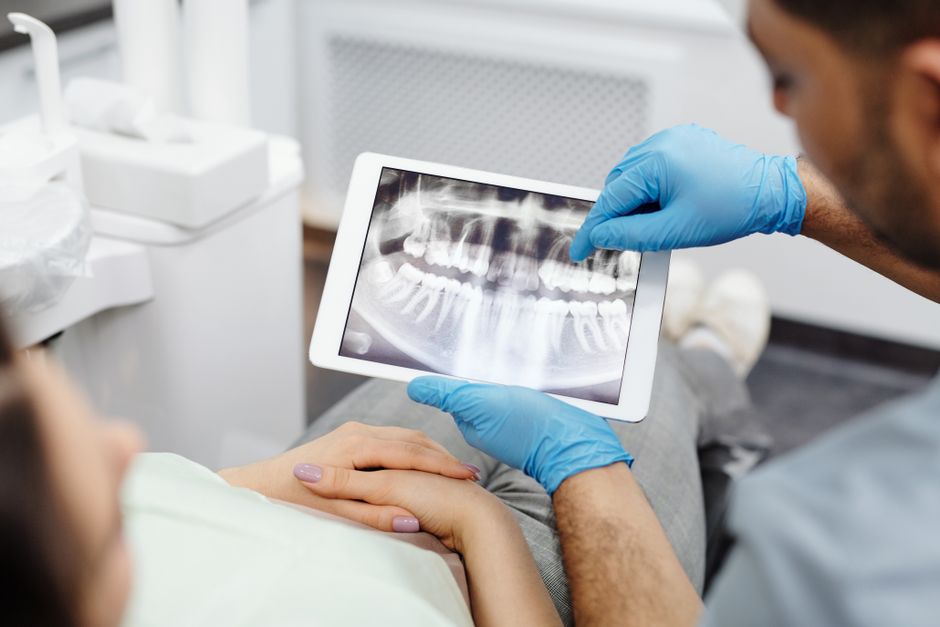
The dentist or hygienist probes gently around the implant to check for bleeding and pus, measures the pocket depth and compares the bone level on X-rays with earlier images. The EFP guidance recommends that clinicians record baseline X-rays and probing measurements once the crown, bridge or denture on the implants is complete. If no earlier records exist, the EFP says peri-implantitis can be diagnosed from the combination of bleeding or pus on gentle probing, probing depths of 6 mm or more and bone at least 3 mm below the top of the part of the implant that sits in the bone.
How peri-implantitis is treated
Treatment follows the same principles as gum disease around natural teeth, and the EFP’s treatment page describes the steps by severity.
Mucositis: cleaning and monitoring
Mucositis is treated with good oral hygiene and professional cleaning, which the EFP says should be done at least twice a year. The EFP adds that implants are less resistant to disease than natural teeth, so patients who lost teeth to gum disease need their implants monitored carefully.
Peri-implantitis: non-surgical first
The first step is professional non-surgical therapy together with chlorhexidine mouthwashes and gels to cut bacterial deposits, plus a check for cement under the gum. The dentist re-evaluates, usually after six weeks. If bleeding and pocket depths have gone down, recall appointments are set according to your needs. In some cases antibiotics are given after non-surgical treatment to help control the infection. The 2023 clinical review says non-surgical treatment suits mild bone loss, and describes its outcomes as limited and unpredictable, with a clear tendency to reinfection.
When surgery is needed
If there is significant bone loss with bleeding and pus that non-surgical therapy has not resolved, non-surgical treatment is repeated first to control inflammation. Then the gum is raised so the defect can be inspected, and the EFP lists these options, often used in combination:
- bone regeneration using bone grafts (see our bone graft guide for how grafting works in general)
- resective surgery, which removes bony ledges and flattens irregularities around the implant
- implantoplasty, where the threads on the implant screw are removed to leave a polished surface
The EFP also stresses thick, firm (keratinised) gum around the implant, which has been shown to prevent and reduce bone loss. Where it is missing, it can be rebuilt with grafts, most commonly taken from the palate.
Results depend on how early treatment starts. The clinical review cites one study in which open-flap surgery with systemic antibiotics gave complete resolution at 53% of implants, and another in which resolution was more common when initial bone loss was 2 to 4 mm than when it was 5 mm (74% versus 40%). These figures come from specific studies, not a promise for any one patient, but they show why waiting costs you options.
When the implant cannot be saved
The EFP says that if the disease progresses, the implant loses its anchorage in the bone and becomes loose, and replacing it may need additional surgery to restore the lost bone. The 2023 review lists severe bone loss of more than 50% of the implant height and implant fracture among the reasons for removal. Our dental implant complications guide covers the other ways an implant can fail.
What treatment costs in the UK
We found no verified UK price list for treating peri-implantitis, and clinics do not publish one in a form we could check, so we give no figure. Because treatment can run from a cleaning appointment to bone-grafting surgery, a single price would not mean much anyway. Ask for a written plan that states the cost of each stage, and ask who carries out the surgical part: your own dentist, or a periodontist you are referred to.
Prevention: what to do at home and what to ask at check-ups
The EFP says the key to preventing peri-implant disease is the same as for gum disease: good oral hygiene at home. Ask your dentist or hygienist to show you how to clean around your particular crown, bridge or denture, because the shape of the restoration decides which tools reach under it. The review quoted above reports that the incidence of peri-implantitis was 18% with regular maintenance versus 43% without (Costa and colleagues), and 27% versus 47% in another study (Roccuzzo and colleagues). Maintenance visits clearly matter.
Questions worth asking your clinic, ideally before treatment starts:
- Will you record baseline X-rays and probing depths once my crown or bridge is fitted?
- How often should I come for implant maintenance, and who will carry it out?
- Will you take annual X-rays of the implants? (The EFP recommends them, because in some patients the disease starts two to three years after placement.)
- If peri-implantitis develops, do you treat it here or refer to a periodontist, and what would the first step cost?
- Is my gum condition suitable for an implant, given any history of gum disease?
If you are referred for surgery, the General Dental Council says dentists can use the title “specialist” only if they are on a GDC specialist list, and its page refers to periodontics among them. For more to ask before you agree to treatment, see our questions to ask at an implant consultation guide, and our aftercare guide for the first weeks after surgery. If you are weighing how long an implant should last with good care, read how long dental implants last.
UK guidance
The British Society of Periodontology and Implant Dentistry reviewed the EFP’s clinical practice guideline on preventing and treating peri-implant diseases to judge whether it suited UK dental professionals, patients and the public, and says its paper is available open access in the Journal of Dentistry. Our summary draws on the EFP patient pages and clinician guidance linked above, so check with your own clinic which protocol it follows.
Frequently asked questions
Can peri-implantitis be cured?
It can be treated, but there is no guarantee. The European Federation of Periodontology (EFP) says some cases need only non-surgical therapy and others need surgery, and that the earlier the disease is found, the better the chances. Its clinical guidance also notes that health can be achieved around implants that have been treated for peri-implantitis. A 2023 clinical review describes non-surgical results as limited and unpredictable, with a tendency to reinfection.
What are the first signs of peri-implantitis?
The EFP lists gums that bleed during brushing and interdental cleaning, swelling, redness, and a bad taste or bad breath. Loosening of the implant, bridge or denture is a later sign. If you notice any of these, book an appointment rather than waiting for your next scheduled check-up.
Can peri-implant mucositis go away on its own?
Not on its own, but it can be reversed. The EFP guidance says there is evidence that mucositis lesions can resolve once plaque-control procedures are reinstated, which means better cleaning at home plus professional cleaning. Left alone, mucositis is assumed to precede peri-implantitis.
How soon after surgery can peri-implantitis start?
The EFP says that in some patients it can start two to three years after the implant is placed. It is the reason the EFP recommends annual radiographs of implants to pick up early bone loss.
Will I lose the implant?
Not necessarily. The EFP says the earlier peri-implant disease is detected, the better the chances of successful treatment. If it is left untreated, the EFP says the implant eventually loses its anchorage in the bone and becomes loose, and it will have to be replaced, which may need additional surgery to restore the lost bone.